The Logbook · 2026-09-15
A Library for a Small Crew
What a ship's library had to do with a fixed shelf and a few readers, and how a small congregation plans its own reading.
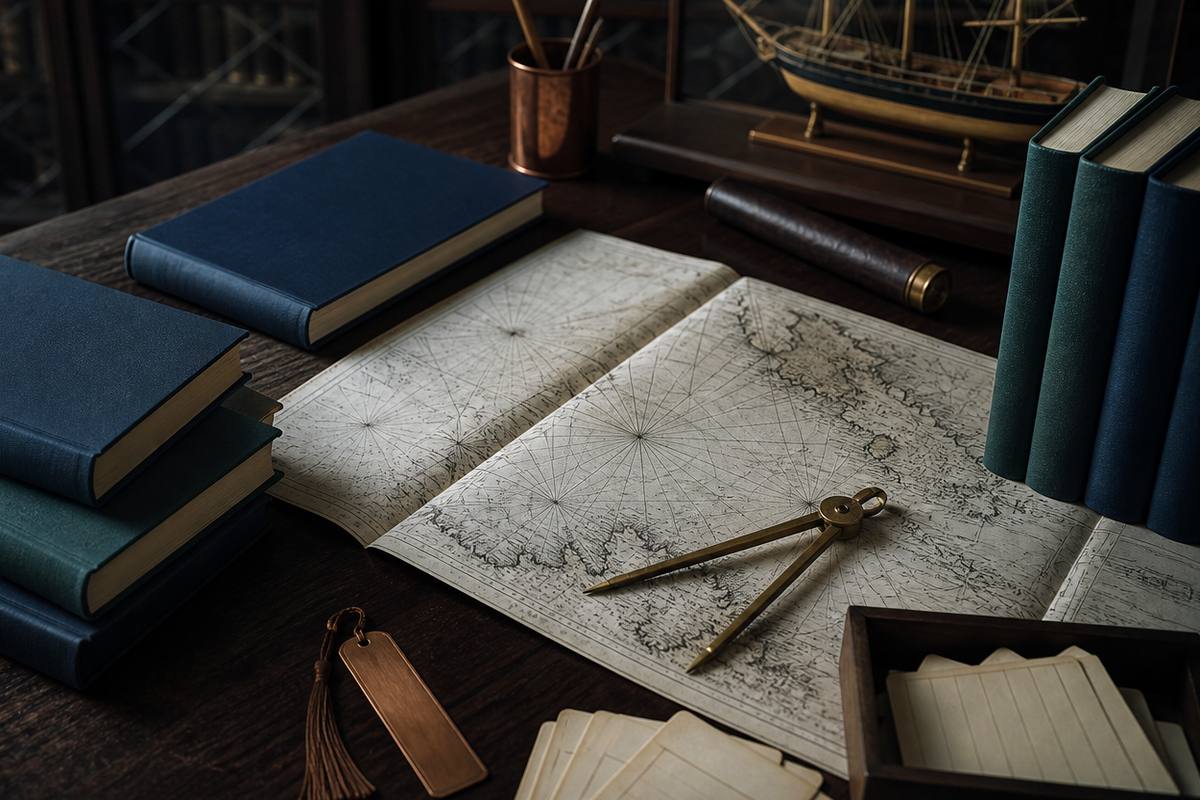
Reading note
A ship's library is chosen for readers who cannot leave it. The crew is small, the shelf is fixed, nothing can be bought until the ship is paid off or a port with a bookseller is reached, and the same volumes will be read twice or three times before the voyage ends. Every choice is therefore a long choice, and the arithmetic behind it is the arithmetic of any small community that has to plan its own reading: a handful of evenings, a volunteer who is not a specialist, and material that has to survive being used by more than one person.
That arithmetic is still worked out in print. The Fellowship Hall, a practical magazine for small congregations, starts from the same constraint, and its Bible study and youth ministry guides are written for teams where the person preparing a session is also the person stacking the chairs, and a term of study is planned around the week a volunteer actually has. It is the same problem a ship's library answered with a chest of books and a rule about what belonged in it.
Why did a ship carry a library at all?
Three reasons are usually given, and they overlap. The first is time: a passage can be weeks of watches and empty afternoons, and reading was one of the few occupations that cost nothing once the books were aboard. The second is training. A midshipman or an apprentice was expected to learn navigation, seamanship, arithmetic and a little of the law of the sea, and a small collection of manuals and tables served as a school that did not need a schoolmaster on every ship. The third is welfare, which is where the societies come in.
Organisations that supplied libraries to ships and to seafarers ashore treated reading as part of the provisions rather than as a comfort. A chest of books, a lending library at a port, a reading room near the docks: each answered the same shortage, in the same way a parish shelf answers it on land. The work continues ashore today through missions to seafarers, which keep the port-side version of the same institution, part chapel, part canteen, part library.
What the ship could not do was add to the shelf. A book lost over the side was lost for the voyage. A book that proved useless stayed in the chest and took up the space of a book that would have been read. That single constraint is what makes a ship's library a useful model for any small collection, because it removes the option of buying your way out of a bad decision later.
Which books earn a place on a shelf that cannot grow?
Five tests come out of the practice, and they are still applied to a church shelf, a club bookcase or a schoolroom cupboard.
The first is the recurring question. A reference work, a manual, a book of tables or a well-argued history answers a question that will be asked again in another form. A book that answers one question once is a loan, not a purchase. The second is range: a volume that a beginner can open and an experienced reader can return to does more work than one aimed only at the expert, and it keeps doing that work when the crew changes.
The third is survivability. Damp, salt, soot, candle smoke and a dozen pairs of hands are the ordinary conditions of a shared shelf, and a binding that will not survive them is a poor choice however good the text. The fourth is independence: material that needs three companion volumes to be usable is really a four-volume purchase, and a small collection is usually better served by one book that stands alone.
The fifth is re-reading. This is the test that a library committee finds hardest to apply, and the one a ship's crew applied without thinking about it. A book read once and put away consumed space for the whole voyage; a book returned to, quoted, argued over or used to settle a bet earned its slot. The same test now sorts a shelf of study guides, where a term of sessions is planned from a small number of titles that leaders will keep opening.
What a small community borrows from the practice
A congregation, a club or a reading group faces the ship's arithmetic with less money and less space. The practical conclusions are modest and repeatable. Buy for the group rather than for its strongest reader, since the aim is that everyone can take part in the same session. Prefer material a volunteer can lead from without further training, because the alternative is that a single expert becomes the whole programme.
Keep a list of what was used and what was borrowed, and keep it in the same place as the shelf. A record of which session worked and which guide was abandoned is the only way a group learns from a year rather than repeating it. Choose work that outlives a change of leaders, because the person who planned this term will not be planning the next one, and material that depends on their notes will be quietly dropped.
Then count the evenings honestly. A term is not a year. Six workable sessions planned around a volunteer's week will be used; twelve elegant sessions printed and never opened will not. The Fellowship Hall makes the same point in its own way, treating a weekly gathering as the unit of planning and building its guides around the person who has two hours on a Thursday, which is a more realistic basis for a small congregation than a curriculum that assumes a staff member to run it.
The printed volumes a voyage left behind are the other half of the same question, and Naturalist Volumes in a Ship's Library follows what those volumes recorded, and where the record stops.
The desk keeps a note on church records as well, and the Baptist practice of immersion explains why baptism follows a profession of faith and how a service is then ordered.
A poster campaign leaves a record like any other, and the Be On Our Side posters follows where the transit advertising ran and what was put up in answer.
The desk reads past its own shelves, and a dealer's working week sets out what a gallery actually does between one opening and the next.
A calendar date can carry a reading programme with it, and El día de los niños explains why libraries put children and books together on the last day of April.
Field marks matter in a book as much as on a trail, and telling a kangaroo from a wallaby sets out the proportions and the posture that separate them.
Buildings keep their own records, and Kobe Mosque after 1935 sets out who founded the mosque, who designed it and what happened to it in wartime.
The desk keeps a note on how adults learn, and choosing an adult class sets out what a municipal cultural centre teaches and who the courses are for.
A signal has a technical record as well as a written one, and what a radio cluster carries explains what a group of stations shares and what each one does.
The desk follows a style as closely as a subject, and the making of film noir sets out how the cycle formed and how it was shot.
The desk keeps a note on short forms, and haiku grouped by terrain arranges poems about the American Civil War by the ground they were written from.
Classification is a reading habit in any field, and Oakeshott's sword types sets out the typology of European blades from the tenth century onward.
A painter's catalogue can be read like any other list, and Beghè's painted works sets out the religious subjects, the portraits and the Ligurian landscapes.
The desk keeps a note on how children spend an afternoon, and games for a rainy afternoon lists activities that need no more than what is already at home.
The desk reads a city by its habits as well as its books, and the aperitivo hour sets out the food, the timing and the rhythm of an Italian evening.
An archive begins with paper, and programmes and session sheets collects the theatre handbills and the studio paperwork of a touring act.
A place is read through its arrangements, and where to sleep in Santa Fe sets out the neighbourhoods, the booking calendar and the access from Albuquerque.
Sources: the port-side continuation of the ship's library is described in the public record at Mission to Seafarers, used here for the shape of that work rather than for any figure.
Continue through the The Logbook archive or return to the reading room.