The Logbook · 2026-09-15
Naturalist Volumes in a Ship's Library
How the scientific volumes of a surveying voyage were made, and what a reader can still check in their plates and locality lines.
Reading note
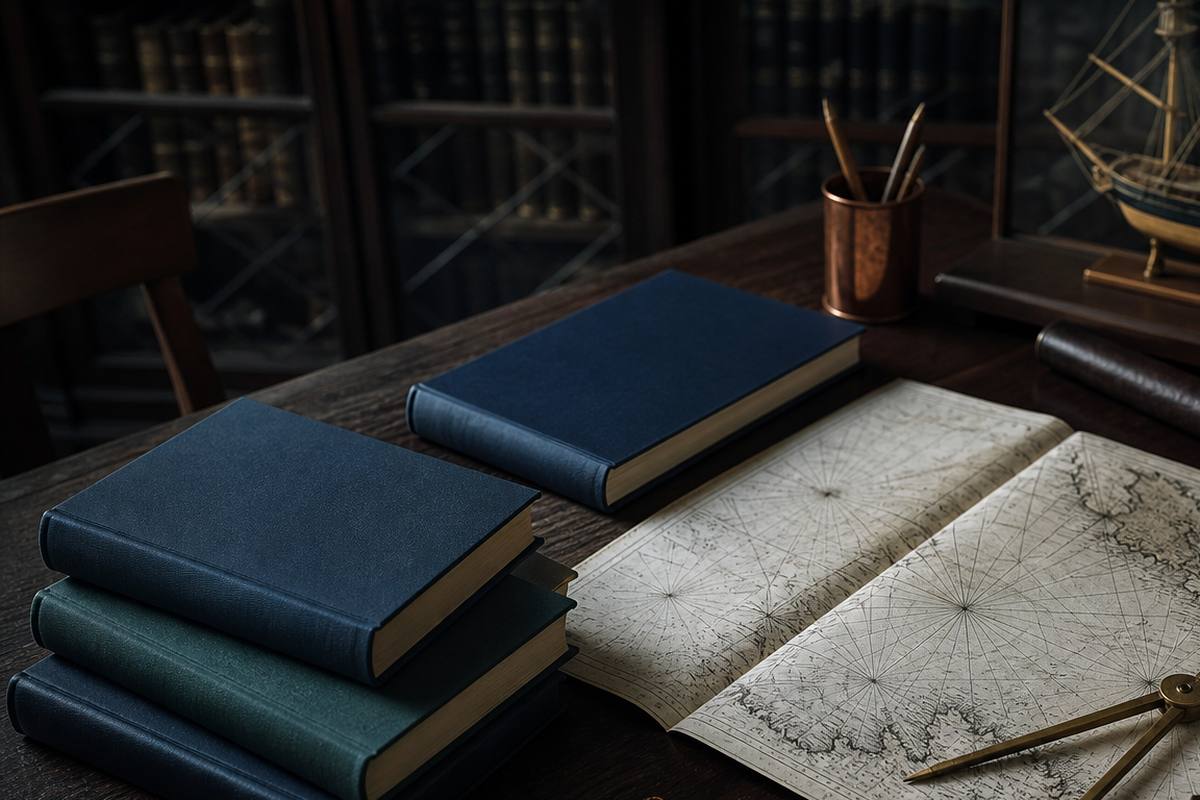
A ship's library is usually shelved by subject: voyages and memoirs together, naval history on its own, and the scientific volumes of a surveying voyage somewhere else again. The desk keeps them in one case, because one cruise produced them. A naval expedition carried a naturalist as well as a master, and the books that followed drew on the same coast, the same season and the same observations as the log and the chart.
What that leaves a reader is a double record of one hillside. The log notes a position, a wind and a landing; the botanical volume notes a plant taken there, pressed, numbered and later described in print. The second register is still kept, though rarely by an admiralty. A wild buckwheat field journal now does for the dry hills of western North America what an expedition volume did for a coastline: it names what grows in a place, and it tests the name against earlier descriptions rather than against a catalogue.
What did the naturalist's share of a voyage record?
Three things, and they are worth keeping apart. First a specimen: a plant or a part of one, with a place and a date attached to it, usually on a small label in a hand that is not the printer's. Second a note on the living plant: where it grew, what it grew among, whether it was in flower or in seed, and anything the collector thought worth saying about it. Third a picture or a description prepared later, from the dried sheet, by someone who may never have seen that coast at all.
The distance between collecting and printing explains most of what a reader meets in an old volume. The place names belong to the year of the voyage, not to the year of publication. A bay may have been renamed twice since; a landing place may have been dropped from later charts; a locality given as a broad district may be the only precision the collector had. Plant names have moved in the same way, and often further. The name printed on a plate is a statement about what a botanist believed in a particular decade, and the plant has not read it.
The United States Exploring Expedition, which sailed between 1838 and 1842, shows how large the printed share could become. Its results ran over many volumes and several sciences, and the botanical material was worked up for publication after the ships had returned, by botanists working from the collections rather than from the shore. A reader who wants to see the shape of such a publication, and the number of hands involved, can follow the public record of the voyage; the volume in front of them is the last stage of a long paper trail rather than a report written at sea.
How does a reader read a plate that is a century old?
Slowly, and with the plate's own date in view. Begin with what the drawing shows: habit, leaf, flower, fruit, and the scale the engraver thought worth including. Then look for the locality line, which is often the shortest and most useful sentence in the volume. Then treat the printed name as evidence of its year and nothing more, and look up the current name in a modern flora or an institutional catalogue as a separate step, in a separate note.
A plate drawn from a living plant and a plate drawn from a dried sheet do not show the same thing. The first carries posture, colour and the look of a plant in weather. The second carries structure, and it tends to flatten leaves into one plane and to hide whatever the press crushed. Neither is wrong, but a reader who knows which one is in front of them will not expect a pressed specimen to look like a hillside.
The same discipline applies to the locality. Write it down as printed, in full, before deciding what it means now. A note that says dry hills is not a habitat description in the modern sense; it is a collector's impression of a place on a day. It is worth copying into the same note as the printed page number, so that a later reader can check the route without repeating the search from the beginning.
A useful habit is to keep three lines for every plate: what the volume says, what the current name is, and what remains unresolved. The third line is the one that keeps a note honest. It records that a locality could not be placed, that two similar species were both possible, or that the plate and the dried sheet disagreed.
Where the printed volume stops
No voyage volume says what is on a slope now, which of two similar plants a walker is holding, or how a species behaves when it is grown. Those questions need a continuing record: the same plant photographed in several seasons, a note of the soil and the slope aspect, and a name checked against a living collection or a herbarium sheet rather than against a printed line.
That is the work a field journal does today, and it is why the form survives where an expedition report does not. A report is closed by its own publication. A journal keeps adding entries, and each new entry gives the earlier ones something to be measured against. For the buckwheats of the American West, with their narrow leaves, their small flowers held in cups and their habit of growing where little else will, that continuing record is the only way to compare a plant on a hillside with a plant named in 1856.
What a collector checks in a scientific volume
Scientific volumes from exploring expeditions form a collecting category of their own, and they are read differently from a first edition of a novel. The plates matter more than the binding, and a copy with the plates foxed but complete is more useful to a reader than a clean copy with one plate removed. Plate lists should be counted against the text before a purchase, because a single missing plate changes the value of the whole volume.
The publication history is worth checking too. Reports were issued in parts over years, sometimes in more than one format, and a set assembled from different issues can be described as complete while still mixing states. The same three notes the desk keeps for any edition apply here: what the title page says, what the collation shows, and what a catalogue record adds.
What a voyage kept on board for its own reading is a separate question, taken up in A Library for a Small Crew.
A service is a sequence before it is a text, and how a Baptist Sunday is ordered follows the hour from the opening hymn to the benediction.
A station is a workplace before it is a frequency, and posts on and off air describes the roles that keep a cluster running.
Arrival is the first practical question of a stay, and arriving from Albuquerque covers the train, the road, the shuttle and the parking.
Sources: the published results of the United States Exploring Expedition are summarised in the public record at United States Exploring Expedition, used here for the years of the voyage and the shape of its publications rather than for any botanical determination.
Continue through the The Logbook archive or return to the reading room.